Volume 5, Issue 2 > Infusion Journal > A Multi-Center Time Study of Home Infusion Nurse Services During Therapy Initiation

A Multi-Center Time Study of Home Infusion Nurse Services During Therapy Initiation

Danell Haines, PhD — Research Consultant
Michelle C. Simpson, PharmD, BCSCP, MWC — National Home Infusion Association
michelle.simpson@nhia.org
Jennifer Charron, RN, MSN, MBA — National Home Infusion Association

Abstract

Introduction
Home infusion therapy is an established and growing model of care that allows patients to receive complex infusion treatments in the home setting. Successful initiation of home infusion therapy requires coordinated nurse, pharmacy, and prescriber involvement, particularly during the transition from referral to the first home visits. Although home infusion nurses perform a wide range of clinical and coordination activities, limited published data describe the time required to deliver these services or how nurse workload varies by therapy type. This multicenter descriptive observational time study quantified home infusion nurse time and task distribution during therapy initiation for anti-infective and intravenous monoclonal antibody therapies.

Methods
Data was collected from November 2024 through May 2025 by nurses employed by participating home infusion providers. Nurses self-reported time spent on patient-specific tasks using standardized tracking forms. Data collection began at referral and continued through the first required visits, including pre-visit activities designated as Visit 0 and the first 2 home visits when applicable. Nurse tasks were categorized as patient assessment and documentation, care plan development, vascular access device care and laboratory monitoring, education, care coordination and telephonic communication, drug administration, travel, and other work-related tasks. Travel time and drug administration time were analyzed separately to avoid duplication when nurses performed concurrent activities.

Results
The study included 44 patients served by 7 providers from the 5 U.S. regions: 28 receiving anti-infective therapy and 16 receiving intravenous monoclonal antibody therapy. Across the study period, nurses documented 309 tasks for anti-infective patients and 115 tasks for monoclonal antibody patients. A greater proportion of anti-infective tasks occurred before the first home visit, with Visit 0 accounting for 22.0% of all anti-infective nurse tasks compared with 5.2% of monoclonal antibody tasks. During Visit 0, care coordination and telephonic communication were the predominant activities, underscoring the importance of pre-visit nurse involvement in safe therapy initiation. Mean total nurse visit time, including travel and excluding drug administration, was 3.93 hours for anti-infective Visit 1, and 2.87 hours for Visit 2. For monoclonal antibody therapy, mean total nurse visit time was 1.27, 4.06, and 3.21 hours for Visits 0, 1, and 2, respectively. Mean round-trip travel time was 1.23 hours. Approximately 40% of nurse patient care time occurred outside the patient’s home for both therapy groups, reflecting care coordination, documentation, telephonic communication, and other non–face-to-face activities.

Conclusion
These findings demonstrate that home infusion nurse workload extends well beyond in-home infusion administration. Although anti-infective and monoclonal antibody therapies differed in task intensity and visit structure, both required substantial nurse time during therapy initiation. Objective measurement of these activities is essential to inform staffing models, productivity expectations, reimbursement policy, and resource allocation for sustainable, high-quality home infusion care.

Keywords: Home infusion, nurse visit, time study, OPAT, Monoclonal antibody, specialty


Introduction

Home infusion therapy is an established and expanding model of care, serving an estimated 3.2 million patients annually in the United States.1 The successful delivery of home infusion depends on a coordinated, multidisciplinary approach involving nurses, pharmacists, and prescribers. Within this model, the initiation of therapy, commonly referred to as patient onboarding, is a critical, resource-intensive phase of care. In the home infusion setting, patient onboarding extends beyond patient education to include clinical assessment, care coordination, therapy planning, and preparation for safe medication administration at home.2 Home infusion nurses play a central role in this process, performing activities such as reviewing clinical information, communicating with prescribers and pharmacists, establishing care plans, and educating patients and caregivers.3 Despite the complexity of these responsibilities, patient onboarding is typically completed within a short timeframe, often within 24 hours.2,4

Transitions of care contribute to the complexity of initiating home infusion. Patients are frequently discharged from acute care settings and require rapid coordination to ensure continuity of therapy. Nurse involvement during this period includes clinical evaluation of patient appropriateness for home infusion, development of individualized care plans, and education to support safe self-administration when applicable. Prior studies have demonstrated that early and intensive nurse engagement during the initial phase of home health care is associated with improved outcomes, including reduced hospital readmissions and earlier identification of adverse events.4,5 Additionally, effective care coordination has been identified as a key determinant of successful outpatient antimicrobial therapy, although coordination challenges remain common.6 These findings underscore the importance of timely and comprehensive nurse services during the initiation of home infusion therapy.

Once a patient is ready to receive home infusion services, the role of the nurse changes from patient onboarding to therapy initiation and clinical management of the patient. Nurse responsibilities continue throughout therapy to include patient assessment, vascular access device management, laboratory monitoring, medication preparation and administration, documentation, patient education, and communication with prescribers and pharmacists regarding a patient’s response to therapy. The nature and frequency of these activities may differ substantially between acute and chronic therapy populations. Anti-infective therapies are commonly short-term (2-4 weeks) treatments requiring frequent monitoring and coordination during periods of clinical instability, whereas specialty infusion therapies, including intravenous monoclonal antibodies, are more often associated with chronic disease management and intermittent infusions over weeks or months. These differences in treatment patterns and patient needs may influence both nurse workload and the distribution of clinical tasks throughout the course of care.

Despite the recognized importance of home infusion nurses, there are limited published studies describing the time required to deliver these professional services. This gap parallels earlier work in home infusion pharmacy, where time-utilization studies were necessary to quantify workload, inform staffing models, and support reimbursement discussions.7,8 Home infusion nurse activities are complex, variable, and influenced by multiple factors, including therapy type, patient acuity, administration requirements, and care environment. A detailed understanding of how nurses allocate time between direct patient care, typically provided in the patient’s home, and indirect activities, such as care coordination, documentation, and travel, is essential for informing workforce planning, optimizing operational efficiency, and supporting policy development.

As the most frequently administered home infusion therapy, anti-infectives are commonly used to treat acute infections in the home setting as an alternative to prolonged hospitalization.3,9 In contrast, intravenous monoclonal antibodies are generally categorized as specialty infusion therapies and are frequently used to manage chronic disease states requiring recurring infusions and ongoing monitoring. According to reimbursement claims data collected between 2022 and 2024, approximately 450,000 anti-infective home infusion patients and 135,000 specialty infusion patients received care in home and alternate infusion sites annually. Although the data did not include monoclonal antibody infusions in a dedicated analysis, during the same period, unique patient claims for specialty infusions increased by 17.3%, reflecting continued growth in chronic infusion therapies.9

The purpose of this study was to quantify nurse time and task distribution associated with home infusion care during the early phase of therapy, defined as the period from patient referral through completion of the first 2 home visits (Visits 0–2). Two clinically distinct therapy categories were evaluated: anti-infective therapies and intravenous monoclonal antibody therapies. The study objectives were to identify nurse task categories overall and by nurse visit while quantifying nurse time both including and excluding nurse travel time. We hypothesized that nurse workload, including both time and task distribution, would differ across therapy types due to differences in treatment complexity, interaction frequency, and patient management needs. By characterizing nurse activities during this defined phase of care, this study aims to provide foundational data to support staffing models, inform reimbursement considerations, and enhance the delivery of home infusion services.

Methods

A descriptive observational time study of home infusion nurses was conducted by the National Home Infusion Foundation (NHIF). The NHIF web page invited all home infusion providers to participate in a multi-center study in which nurses self-reported time spent on tasks related to anti-infective and IV monoclonal antibody patient care, including those performed outside the patient’s home, as well as those conducted in the patient’s home. Since home infusion requires nurses to travel to patients, travel time data was also collected. The nurses at the participating provider locations received an orientation video, a data entry guide, and patient-tracking Excel® spreadsheets. Participating nurses were required to be employed by the provider. Contracted nursing services were excluded from the data collection. The home infusion patients tracked for this study were new patients recently referred for home infusion by their physician. Patients who received care in the clinic or infusion suite were excluded from the study.

Data Collection

A volunteer home infusion nurse expert committee was utilized to determine the data collection time frame, nurse task categories, and examples of tasks within each category (Figure 1). The data collection time frame for anti-infective started at time of referral for home infusion and included a minimum of 1 nurse visit while IV monoclonal antibody therapy included all nurse visits to complete 2 infusions. Other variables collected in this study included patient age, drug administration method, if the nurse task was completed inside or outside of the patient’s home and the nurse visit number (0, 1, or 2). Nurse Visit 0 represents nurse tasks completed prior to the first patient visit. Prior to the first patient home visit, there are specific nurse tasks and time dedicated to patient care. Those tasks and time usually occur without direct face-to-face contact with patients. Examples of a nurse task prior to the first patient home visit would be care coordination and telephonic communication.

Data collection was conducted from November 2024 through May 2025 and involved nurses self-reporting the task category and amount of time (minutes) spent on each patient task using an Excel® file for each patient serviced (Figure 2). Using retrospective recall, nurses tracked the time spent on a task category for a given patient immediately after completing the task. For example, if the nurse was assessing the home environment and caregiver status, the task category was “1.” After completing the task, the nurse noted the total task time directly related to their role in the tracking form.

Analysis

The data from 44 submitted nurse time forms, 28 anti-infective patients and 16 monoclonal antibody patients, were combined into a single Excel® file. This file included all nurse tasks for nurse Visits 0, 1, and 2 and was imported to IBM SPSS (Statistical Product and Service Solutions) Version 31 for additional analysis. The data was reviewed by an expert panel to identify outliers and data entry errors. Using the Winsorization statistical method, outlier data were replaced with the largest or second smallest value, while data entry errors were replaced with the mean score.

Anti-infective and IV monoclonal antibody data were analyzed independently, except for nurse travel time, which is not therapy dependent. Travel time data was aggregated to calculate the mean and standard deviation; these figures were reported both as a metric and as a component of nurse time. While patient age was summarized using mean and standard deviation, drug administration methods and nurse tasks were analyzed using frequencies and percentages. Travel time was excluded from the categorical analysis of nurse tasks. Nurse task frequencies and percentages were also determined for each nurse visit (Visit 0, 1, 2). The nurse tasks completed prior to the first nurse patient visit were designated as Visit 0.

To meet the study’s nurse time objective, 2 overall nurse times were defined and calculated:

  • Nurse visit time: Nurse patient time in and out of the patient’s home summed plus travel time.
  • Nurse patient care time: Nurse patient time in and out of the patient’s home reported separately and without travel time.

Nurse time varies by visit; therefore, nurses’ time was calculated for Visit 0, 1, and 2. Each patient’s nurse’s time was determined for each visit. The patient times were totaled for each visit and divided by the number of patients served during the visit. Since nurses multi-task during drug administration, also noted as infusion, the task was not included in the time calculations and was reported separately.

IRB (Institutional Review Board) Status

The patient’s care plan was not impacted by this study. All patient care data were retrospectively recorded. No identifying patient data was provided by the participating provider locations. Furthermore, the provider’s location was de-identified using a data participation code (DPC) provided by a 3rd-party consultant. This study was therefore exempted from IRB review. To ensure that both the provider and patients were de-identified, the patient code was the provider’s unique DPC followed by a 2-digit patient identifier, known only to the participating nurse and 3rd-party research consultant.

Results

This multicenter study investigated nurse tasks and time among 44 patients served by 7 unique home infusion providers across all 5 regions of the United States. There were 309 nurse tasks for the 28 anti-infective patients and 115 tasks for the 16 IV monoclonal antibody patients. Data collection began at the time of patient referral. For anti-infective patients, this included at least 1 nurse visit, while monoclonal antibody therapy data covered all visits required for 2 infusions. No data was collected beyond this time frame even though patients may have received additional health care. Effective home infusion care necessitates the collaboration of a multidisciplinary team; while nursing is a cornerstone, the process also relies on the concurrent contributions of physicians, pharmacists, and dieticians.

The mean patient age was 51.47 years (SD=18.60) for anti-infective patients and 46.06 years (SD=15.92) for IV monoclonal antibody patients. Anti-infective patients were infused using 4 administration methods: elastomeric, IV push, ambulatory infusion pump, and gravity. Most patients (39.20%) used the elastomeric method. For monoclonal antibody administration, gravity was the primary method at 75.00%, while ambulatory infusion pumps accounted for the remaining 25.00%.

Home Infusion Nurse Tasks

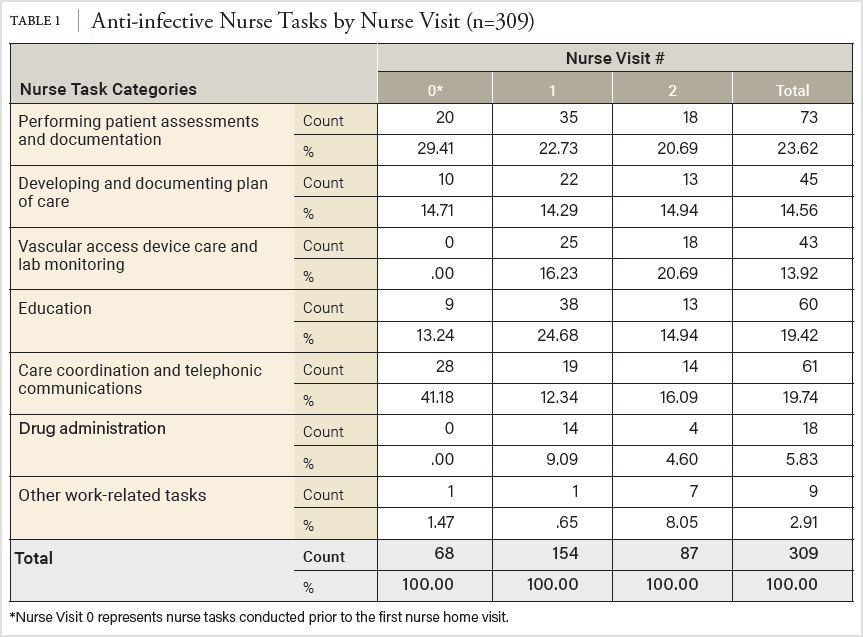
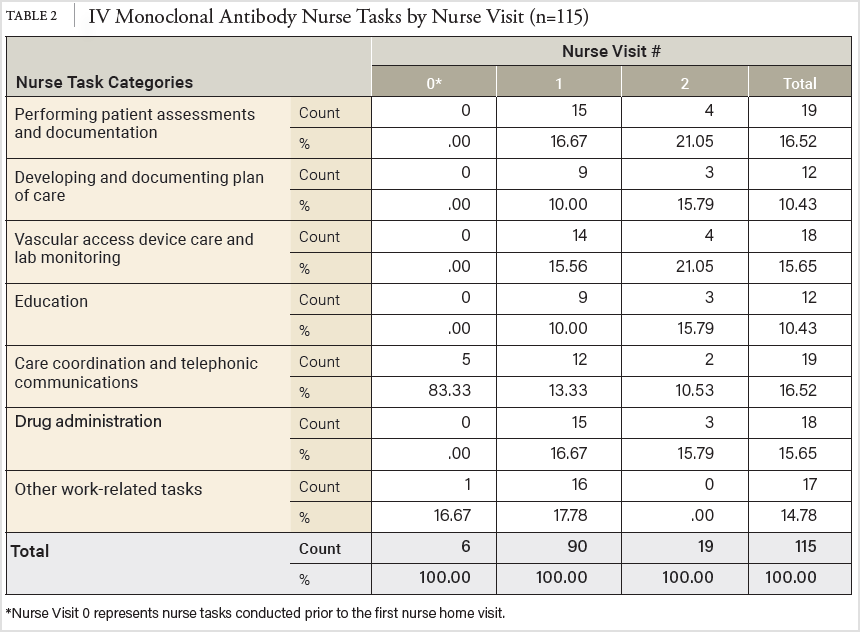
Nurse task data was grouped into 8 categories as shown in Figure 1. Analysis of the 8 categories reveals both consistent and disparate patterns between anti-infective and intravenous (IV) monoclonal antibody therapies (Figures 3 and 4). While both therapeutic modalities demonstrate a high percentage of tasks in the categories of “patient assessment and documentation” and “care coordination and telephonic communication,” significant disparities exist in other task categories. Specifically, patient education constitutes a higher proportion of total tasks for anti-infectives (19.42%) compared to IV monoclonal antibody therapy (10.43%), whereas drug administration represents a lower proportion for anti-infectives (5.83%) than for IV monoclonal antibody (15.65%).

Home infusion nurse time starts prior to the nurse’s first home visit and includes a variety of tasks. Half of the anti-infective patients (n=14) and one-fourth of the monoclonal antibody patients (n=4) had nurse tasks completed prior to the first home nurse visit. These tasks are labeled as Visit 0. As shown in Figure 5, 68 (22.00%) of the 309 nurse tasks for anti-infective patients were conducted during Visit 0 with care coordination and telephonic communications accounting for 41.18% (n=28) of the nurse’s tasks (Table 1) during this phase. This is considerably different from the IV monoclonal antibody patients, who required only 6 (5.22%) of the total 115 tasks during Visit 0 (Figure 6). Unknown variations in hospital-to-home transition care may explain the differences in task volume and time during nurse Visit 0.

For both therapy types, most nurse tasks were performed during nurse Visit 1, as shown in Figures 5 and 6. For the anti-infective patient, almost half (n=154) of all nurse tasks collected during the study timeframe occurred during this visit, while 78.26% (n=90) of all tasks for the IV monoclonal antibody patients occurred at this time (Figure 6).

The most common nurse tasks for anti-infective patients during Visit 1 were patient education, patient assessment and documentation, and vascular access device care and lab monitoring (Table 1). For IV monoclonal antibody patients, “other work-related tasks” category had the highest percentage of tasks at 17.78%. This might be due to the individualized care needed for these patients. The next highest percentage of tasks were in the “patient assessments and documentation” and “drug administration” categories (Table 2).

For both patient therapy groups, nurse Visit 2 is considerably different from Visits 0 and 1. The most common nurse task categories during Visit 2 for both therapy groups were vascular access device care and laboratory monitoring, and patient assessment and documentation. Even though nurse task and time data were only collected through Visit 2, home infusion nursing remained constant until therapy was complete.

Home Infusion Nurse Time

To meet the objective of this study, this analysis quantifies the amount of time that a home infusion nurse spends with a delineation for patient care time. Nurse time and nurse patient care time was defined and calculated as follows:

  • Nurse visit time: Nurse patient time in and out of the patient’s home summed plus travel time.
  • Nurse patient care time: Nurse patient time in and out of the patient’s home reported separately, but no travel time.

One of the 8 nurse task categories is drug administration. Due to the time-intensive nature of this task, the nurse may complete other tasks concurrently, such as patient education, patient assessment and documentation, and monitoring. To avoid duplication, the time for drug administration is not included in the estimated total visit time or patient care time. In this study, the mean administration time for a home anti-infective infusion is 49 minutes (SD=42 minutes), whereas IV monoclonal antibody infusions averaged 1 hour and 55 minutes (SD=1 hour 7 minutes).

To be complete, this study must account for nurses’ travel time to and from patient homes, which can represent a significant portion of the total nurse task time. The mean nurse’s round-trip time for the 44 tracked patients is 1.23 hours (SD=0.70 hours) with a minimum of 0.15 hours and a maximum of 3.50 hours. The median time is 1.16 hours. To ensure accurate accounting of the home infusion nurse visit time, travel time is included in the total nurse visit time.

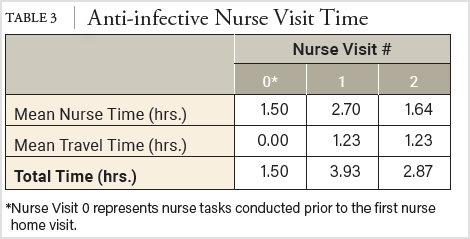
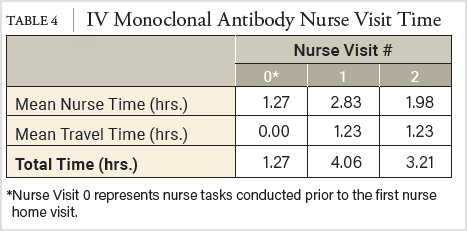
The focus of this section is nurse visit time, defined as nurse patient time plus round-trip travel time, excluding drug administration. The nurse visit time is categorized into nurse Visit 0, 1, and 2 (Table 3 and 4). Prior to the first anti-infective nurse home visit, defined as Visit 0, the nurse spends an average of 1.50 hours completing tasks such as care coordination, telephonic communication, patient assessments, and documentation. The nurse’s average patient care time for an IV monoclonal antibody patient during Visit 0 is 1.27 hours and primarily involves care coordination and telephonic communication. Of the nurse visits, Visit 1 requires the most time with anti-infective patients averaging 3.93 nurse hours and IV monoclonal antibody patients averaging 4.06 (Table 3 and 4, Figure 7 and 8). A Visit 2 involved 64.29% of the anti-infective patients (n=18) and 25% (n=4) of the monoclonal antibody patients. The mean time of the visit with travel time included for anti-infective and monoclonal antibody patients was 2.87 and 3.21 hours respectively.

Recognizing that home infusion nursing occurs both inside and outside the patient’s home, this section details nurse patient care time, defined as nurse patient time in and out of the patient’s home reported separately, but no travel time. Outside the patient’s home nurse care involves care coordination, phone consultations, care plan documentation, and related administrative tasks; however, it does not involve face-to-face contact with the patient. Of the patient’s total nurse care time 41.78% and 41.00% is spent outside of the patient’s home for anti-infective and IV monoclonal antibody patients, respectively, while 58.22% and 59.00% of the time is spent in the patient’s home (Table 5 and 6 and Figures 9 and 10).

Of the patients, 12 anti-infective and 4 monoclonal antibody, that received Visit 0 care, anti-infective patients needed 1.5 hours of service while monoclonal antibody patients needed 1.27 hours. All patients had a Visit 1 care with monoclonal antibody needing approximately 2.83 hours and anti-infective patients needing 2.70 hours. Analysis shows that nurse patient care time across in home/out of home settings and visits did not vary substantially by therapy type.

Discussion

This multicenter study provides a detailed characterization of home infusion nurse time and task distribution during the initial phase of therapy, defined as patient referral through the first 2 home visits (Visits 0, 1, and 2). The findings demonstrate that nursing care extends substantially beyond in-home infusion activities, with a significant proportion of time devoted to travel, care coordination, patient assessment, education, and documentation. Notably, a meaningful portion of nurse work occurred prior to the first home visit (Visit 0), particularly among anti-infective patients, in which coordination and communication activities accounted for a large share of total tasks. These results highlight the critical role of early nurse involvement in facilitating safe and timely initiation of therapy. In the absence of this pre-visit work, delays in treatment initiation, gaps in patient education, and an increased risk of complications may occur.

Differences observed between anti-infective and intravenous monoclonal antibody therapies reflect the importance of therapy-specific workload considerations. More nurse tasks were performed during anti-infective visits, indicating greater task intensity related to ongoing monitoring, frequent education, and care coordination commonly associated with outpatient parenteral antimicrobial therapy. In contrast, monoclonal antibody therapies were associated with fewer discrete tasks but longer and more variable visit durations, driven by infusion administration time, vascular access requirements, and post-infusion monitoring for potential adverse reactions. Despite these differences in task distribution and visit structure, total nurse time across Visits 0, 1, and 2 was similar between therapy groups. This finding suggests that nurse workload may vary by therapy characteristics, with task-intensive versus time-intensive patterns emerging across therapy types. These distinctions have important implications for staffing models, competency development, and workload expectations, particularly given the specialized clinical skills required for infusion therapy and adherence to established practice standards.

An additional key finding is the substantial contribution of non–patient-facing activities and travel time to overall nurse workload. Approximately 40% of patient care time occurred outside of the patient’s home, reflecting time spent on care coordination, documentation, and telephonic communication. These activities are essential to safe and effective care delivery but are often less visible in traditional productivity assessments. Insurance reimbursement for home infusion nurse services generally requires the nurse’s physical presence in the home to bill for time spent on patient care, meaning the tasks and the nurse’s time devoted to Visit 0, and other tasks that occur outside the patient’s home are not reimbursed.10

Most home infusion nurses have substantial clinical experience (6+ years), backgrounds in intensive care, medical-surgical care, and emergency departments, and specialized certifications directly related to home infusion therapies.11 According to the Bureau of Labor Statistics, a Registered Nurse’s median pay was $45 per hour in 2024 without adjusting for background and experience.12 Considering that 40% of patient care time occurs outside the patient’s home and is therefore not reimbursed, the home infusion provider will still need to pay the nurse for their time.

Travel time was also consistent across therapy types, with a mean round-trip time exceeding 1 hour, highlighting the geographic considerations inherent in home infusion service delivery and their potential impact on patient access. These findings are consistent with prior home infusion pharmacy studies demonstrating that a significant portion of clinical work occurs outside of direct patient encounters, yet remains critical to patient outcomes.7,8 Collectively, these results support the need for operational models and reimbursement frameworks that account for the full scope of nurse services, including indirect care activities.

Although anti-infective and monoclonal antibody therapies differed in the number and type of nurse tasks performed, cumulative visit time was similar between groups. Across Visits 0, 1, and 2, monoclonal antibody patients had a mean total visit time of 6.08 hours, compared with 5.84 hours for anti-infective patients. This finding suggests that differences in task intensity did not result in large differences in total nurse visit time. The therapies appear to reflect different workload patterns, with anti-infective visits involving more frequent nurse activities and monoclonal antibody visits involving fewer tasks but comparable time demands related to infusion administration and monitoring.

The findings of this study have several practical implications. First, they provide objective data to inform staffing models and workload expectations for home infusion nurses, particularly during the initial phase of therapy when care coordination demands are highest. Second, they highlight the importance of incorporating non–patient-facing activities into workflow design and productivity metrics. Third, these results may inform the development of training and orientation programs by identifying high-frequency and high-time tasks essential to practice. Finally, the data contribute to ongoing discussions regarding reimbursement for home infusion services by demonstrating the variability and complexity of nursing work required to safely initiate and manage therapy in the home setting.

This study highlighted distinct differences in nurse tasks and time requirements between anti-infective and monoclonal antibody therapies. Future research should expand on this by examining other therapy types, such as parenteral nutrition, inotropes, and immune globulin. In the home and specialty infusion industry, it is widely recognized that nurses spend a significant portion of their time on non-clinical onboarding tasks. This study quantifies that commitment, offering robust data on the actual time spent. Consequently, future research should focus specifically on this element to better understand its impact. If this study is replicated, it is suggested that the nurse task category “patient assessment” and “electronic medical record documentation” should be categorized as 2 separate tasks rather than one due to their differences.

Study Limitations

The study results can only be generalized to the initial visits for anti-infective and IV monoclonal antibody therapy nurse time, patient care time, and the drug administration methods reported. Data was not collected on whether the nurse was the same nurse for all tasks and visits for a patient, but it is assumed that other nurse clinicians completed some of the tasks for a patient since many home infusion providers utilize nurse teams to provide comprehensive care. The most common limitation of this self-report time study is the potential for nurses to be more productive since their tasks and time were tracked. This phenomenon is noted as the Hawthorne effect and is common in self-report research.13 Even so, self-report is commonly used to collect time utilization data.

Conclusions

These findings show the importance of recognizing the full scope of nurse work that supports successful home infusion therapy. Although anti-infective and monoclonal antibody therapies differed in task intensity and visit structure, both groups involved meaningful nurse time across early visits, including Visit 0 activities related to preparation, education, coordination, and support for therapy initiation. This work is essential to patient transitions, safety, adherence, and successful outcomes. Collecting data and documenting these activities are needed to accurately represent nurse workload and to inform staffing, reimbursement, and resource allocation models that support sustainable, high-quality home infusion care.

Disclosures: Study funded by contributions made to NHIF.

Commentary: When reviewing a manuscript submitted by one of Infusion Journal’s editors or staff, the author is deliberately excluded from all aspects of the review process. The Editor-in-Chief or alternate editor is responsible for handling the peer review process independently of the author. The author is not aware of the choice of peer reviewers and is not present when discussing the manuscript at editorial meetings.

Acknowledgment
We express our sincere appreciation to Laura Luckow, MSN, BSN, CRNI, for her valuable contributions to this study. Her clinical insight informed the research design and protocol development, and her thoughtful review of the final manuscript strengthened the article. We appreciate her insight and time invested in this project.

References

  1. National Home Infusion Foundation (NHIF). Infusion Industry Trends 2020. Alexandria, VA: NHIF, 2020.
  2. Haines D, Garst R. Pharmacists’ Role in Onboarding Patients for Home Infusion Therapy. Infusion Journal. 2022;1(3):18-24. doi: 10.70776/wzin2475.
  3. Putzke KA. The Keys to Planning Successful Home Infusion – Admission Criteria. Infusion Nurses Society. INS. September 12, 2024.
  4. Song J, Zolnoori M, McDonald MV, et al. Factors Associated with Timing of the Start-of-Care Nursing Visits in Home Health Care. Journal of the American Medical Directors Association. 2021;22(11):2358-2365.e3. doi:10.1016/j.jamda.2021.03.005
  5. Madaline T, Nori P, Mowrey W, et al. Bundle in the Bronx: Impact of a Transition-of-Care Outpatient Parenteral Antibiotic Therapy Bundle on All-Cause 30-Day Hospital Readmissions. Open Forum Infectious Diseases. 2017;4(2) doi:10.1093/ofid/ofx097
  6. Hamad Y, Lane MA, Beekmann SE, Polgreen PM, Keller SC. Perspectives of United States–Based Infectious Diseases Physicians on Outpatient Parenteral Antimicrobial Therapy Practice. Open Forum Infectious Diseases. 2019;6(10) doi:10.1093/ofid/ofz363
  7. Haines D, Garst R, Sullivan C, Charron J. A Multi-Center Time Study of Home Infusion Pharmacist Professional Services. Infusion Journal. 2022;1(1):1-9. doi:10.70776/dhge6689
  8. Simpson M, Vermeulen D, Haines D. A Multi-Center Time Study of Home Infusion Pharmacist Professional Services for Specialty Infusion Medications. Infusion Journal. 2024;3(3):5-13. doi:10.70776/lnsk6470
  9. National Home Infusion Foundation (NHIF). Infusion Industry Trends 2025. Alexandria, VA: NHIF, 2025.
  10. Social Security Act, 42 U.S.C. § Section 1834(u)(1)(A)(ii) (2021). Accessed March 2026.
  11. Haines D, Counce J, Charron J. Association Between Years of Nursing Experience and Clinical Background Among Home Infusion Nurses: A Descriptive Workforce Assessment. Infusion Journal. 2024;3(2):5-11. doi:10.70776/wcfg3587
  12. Bureau of Labor Statistics, U.S. Department of Labor, Occupational Outlook Handbook, Registered Nurses, at https://www.bls.gov/ooh/healthcare/registered-nurses.htm (Accessed March 2026).
  13. Goodwin MA, Strange KC, Zyzanski SJ, Crabtree BF, Borawski EA, Flocke SA. The Hawthorne effect in direct observation research with physicians and patients. J Eval Clin Pract. 2017 December; 23(6): 1322–1328. doi:10.1111/jep.12781.